Encore une Maghrébine métissiste noirophile et panafricaniste qui avance des propos sans aucun sens ni chronogie historique pour faire un rapprochement entre les Berbères et les ethnies congoïdes. Le signe berbère du "yaz" n'est pas propre aux Berbères, et pas lié au kanaga des Dogons : il n'y a pas de lien en ce signe qui soit spécifique à ces deux cultures. - L'origine de ce signe est un anthropomorphe phallique (…

Channel
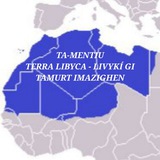
Ta-Mentiu - Terra Libyca - Livykí gi
@tamentiu
On this record: Growth · Engagement · What this channel posts · Reactions · Posts · Citations · Cite this entry
30subscribers
+0 since we began measuring on 7 August 2026
Risers and fallers across the register · movement among entries of Under 1,000.
Register entry
| Telegram ID | -1002278392912 |
|---|---|
| Type | Channel |
| Username | @tamentiu |
| Description | tꜣ-mntjw / Ta-Mentiu ; tꜣ-rbw / Ta-Rebu The oldest known name of the Libyc (Berber/Amazigh) land territory Tamurt Imazighen تامورت إمازيغن Land of the Amazighs تامازغا أرض الأمازيغيون Trierra de los Amaziges Terre des Amazighs Λιβυκή γη / Livykí gi |
| Created | Between 1 September 2024 and 11 February 2025— estimated from Telegram’s id allocation, not measured. How this range is calculated. |
| First recorded | 11 August 2026 |
| Last confirmed live | 14 August 2026 |
| Measurements held | 2 |
| On Telegram | t.me/tamentiu |
Growth
| Measured (UTC) | Subscribers | Change |
|---|---|---|
| 11 Aug 2026, 04:30 | 30 | no change |
| 7 Aug 2026, 08:03 | 30 | first reading |
Engagement
10 posts held, back to 11 February 2025 — the reader has not yet reached the start of this channel’s public history, so older posts may sit further back, unread. Read across 1 pageof Telegram’s post history, 20 posts per page.
Nothing published in the last 30 days. ERR and ER are rolling 30-day measures, so there is nothing to compute — we hold 10 posts for this entry, the most recent from 19 December 2025. An engagement rate over an empty window would be a number about nothing.
What this channel posts
- Photos
- 29
- Links
- 20
Lifetime counters from Telegram’s own channel header, read 11 August 2026 — not the date at the top of this page, which is when the subscriber count was last read. Below Telegram’s rounding threshold, so these counts are exact.
Reaction mix
1 reaction across 1 post, in 1 kind.
| Reaction | Count | Share | Share, drawn |
|---|---|---|---|
| 👍 | 1 | 100.0% |
No sentiment is inferred, and none should be read in. This table is ordered by count and by nothing else. Emoji do not carry stable meaning across languages or communities — 🙏 is thanks in one channel and mourning in another — so we publish which ones were pressed and how often, and pass no judgement on what an audience meant by them.
Precision. Telegram publishes reaction counts per emoji and short-forms each one — 4.34K, 1.2M — so any single kind at or above 1,000 reaches us at three significant figures, and only counts below 1,000 are exact. The shares above are ratios of those figures and carry the same error. This is also why the total here can differ slightly from a reaction total printed elsewhere on the page: both are sums of the same rounded parts, taken over samples with different edges.
Coverage. Reactions were read on 3 of the 10 sampled posts in this sample. Summed by Telegram’s own count on each post — not by adding up the per-emoji breakdown above — those same posts carry 1reactions in total: the kind of figure the paragraph above means by “a reaction total printed elsewhere on the page”.
Measured over the 10 most recent posts we hold, published 11 February 2025 to 19 December 2025, using the newest reading held for each. Telegram Stars are excluded: they are a payment, not a reaction, and they have their own section.
Recent posts
L'exode massif des berbérophones, ruraux, vers les zones urbaines fut encouragé - pour ne pas dire stratégiquement organisé - par la politique arabiste et panarabiste menée sous Habib Bourguiba, par le biais d'une centralisation l'ensemble du territoire, d'un développement focalisé sur les grandes villes et d'une marginalisation des villages et zones rurales. https://t.me/tamentiu
Arabisation de la Tunisie : une politique linguistique linguicide [et ethnocidaire] multi-coloniale La politique d’arabisation enclenchée en 1956 [suite à l'indépendance et la création de l'État tunisien] a partiellement arabisé les zones [berbérophones] de Tamazret, Matmata, Guermassa, Guellala, Chenini, Douiret, Zraoua, Taoujout, Tamazret, Sedouikech, Ajim, Oued Zeib, Douiret, Ras El Oued, Bir Thlathine Jarjer, Gh…
Photo, posted without a caption
Cela s'inscrit dans la mentalité impérialiste et coloniale suprémaciste de l'empire romain et ses acteurs - élites et aristocrates -, dont l'impérialisme n'est que la face cachée du mondialisme de l'époque visant au contrôle par l'assujettissement. Cela démontre aussi les ressemblances dans les us et coutumes et le mode de vie des peuples occidentaux premiers, fortement tribaux et dont les sociétés tribales étaient …
Comment les colons et les Romains percevaient les peuples de l'Ouest : Libyens (Berbères anciens), Ibères, Celtes et Germains. Pour les colonisateurs il s'agissait de Barbares « incultes » (comprendre : insoumis) qu'il fallait à tout prix civiliser (càd soumettre) grâce à la colonisation de l'Empire, se considérant plus « civilisés ». Histoire romaine, Volume 7; Theodor Mommsen, Charles Alfred Alexandre, René Cagnat…
Dulie et hagiolâtrie (culte des « saints ») : Saint et Sidi. Deux cartes intéressantes sur l'hagiologie de l'Occident chrétien et l'Occident musulman qui mettent en évidence les toponymes de villes et villages qui commencent par « Saint » en Europe et par « Sidi » en Afrique du Nord des deux côtés de la Méditerranée. On constate que la croyance aux saints et la sacralisation de figures historiques religieuses est for…
The skin color of peoples known by ancient Egyptians according to Egyptian frescos. Egyptians: red-skinned, Nubians: Black ; Libyans: white ; Canaanites: dark-brown. https://pin.it/4tJSNOYAO https://t.me/tamentiu
👍1
Tomb of Seti I, Book of Gates, 4th Division, 5th Hour. From left to right: an Egyptian (Rmt/Remet ; Copt/Coptic), a West Asian (Aamu ; Semit/Semitic), a Nubian (Nhsyw/Nhsw/Nehesyu/Nehesu, Sub-Saharan), a Libyan (Tjhnw/Thnw/Tjehenu/Tehenu ; Berber/Libyc). https://pin.it/3Fhu1cnNp https://t.me/tamentiu
* A Libyan [Ancient Berber] chieftain from the Late Bronze Age, drawing by J.F. Oliveras * Un chef de tribu libyen [berbère ancien] de l'âge du bronze tardif, dessin par J.F. Oliveras * Un jefe tribal libio [bereber antiguo] de la Edad del Bronce final - https://www.artstation.com/artwork/DL2xO0 - https://pin.it/7HdIirlAU https://t.me/tamentiu
Showing the 10 most recent of 10 posts we hold for @tamentiu. View and reaction counts are the latest single reading for each post, not a live figure, and a recent post is still accumulating both. A view count marked ≈ was rounded by Telegram before we ever saw it — t.me prints views in full below 1,000 and to three significant figures above, so ≈1,200,000 means somewhere between 1,150,000 and 1,249,999. Unmarked counts are exact. Text is reproduced from the public post preview and truncated for length.
Citation-graph rank
Citation-graph rank — 359,922 of 1,480,944entries in the measured graph. A weighted position computed from the forward and mention edges below — republished posts weigh more than named mentions — and recomputed periodically, over the whole graph. Published only as this ordinal position, never as a score: a position is a fact, and a score printed beside one channel’s name would read as a verdict this register does not make. The two counts beneath stay separate for the same reason mentions are never summed with forwards anywhere else on this page — a named-by count costs nothing to manufacture. The top 100 by this measure, or how it is computed.
Forward network
Republished by
Channels on the register that have forwarded this channel's posts into their own feed.
Republishes
Channels on the register whose posts this channel has forwarded.
Built only from forwarded posts we have actually read, on both sides. Coverage is early and deliberately incomplete: a missing link means we have not read the post that would prove it, never that the relationship does not exist. Counts are distinct forwarded posts observed, so they only ever go up as we read more.
Mentions
Named by 2 registered channels — every channel on the register whose own posts have named this one, by its current username or any other username it currently holds, merged from two separately captured readings of the same fact so a namer caught by only one of them is not missed and a namer both caught is not counted twice. A username this channel has since dropped is not matched — that handle may belong to someone else now, and crediting today’s namer to yesterday’s owner would misattribute it.
Named by
Channels on the register whose posts name this channel's handle.
Names
Channels on the register whose handles appear in this channel's posts.
A mention is a weaker signal than a forward and is counted separately for that reason — naming a channel is not republishing it, and a handle in a post body is easy to place deliberately. The post counts beside each row below are distinct posts in which the handle appeared, from posts we have read on both sides — the “Named by N registered channels” figure above is a different count, of distinct NAMING CHANNELS rather than posts, and is not the sum of the rows under it.
Cite this entry
A live page changes as we take new readings, so a citation should name the measurement it is based on, not just the URL. The line below cites the subscriber count as measured 11 August 2026 — this entry's latest reading, not the date you are reading this.
“Ta-Mentiu - Terra Libyca - Livykí gi” (@tamentiu), 30 subscribers as measured 11 August 2026. Telegram Register, tgregister.com/channel/tamentiu.
Full measurement history, CC BY 4.0. Every reading this register holds for this entry, not just the latest one, as a dated, downloadable record: CSV · JSON. Free to use with attribution to tgregister.com. Each file carries its own generation timestamp, which is the figure to cite for exactly when the data was retrieved.