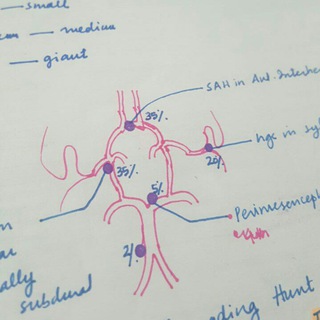
8 Oct 2024, 21:35 UTC≈3,630 viewsread 26 August 2026 #WhatNext NF2
1. Post contrast images of whole neural axis.
2. Refer to neurology.
3. Family screening: CE MRI whole neural axis.
4. Look for ocular 👁️ abnormalities in pediatric patients.(More common)
MZeba
19 Sept 2024, 17:58 UTC≈3,960 viewsread 26 August 2026 HIV Encephalitis:
💫Affects subcortical and periventricular white matter, possibly the basal ganglia and thalamus.
💫Lesion Characteristics: T1: Hypointense, T2: Hyperintense, FLAIR: High signal
💫Enhancement: Generally no post-contrast enhancement; mild enhancement may occur in some cases.
💫Associated Findings: Cerebral atrophy and ventricular enlargement.
MZeba
18 Sept 2024, 18:11 UTC≈3,290 viewsread 26 August 2026 Progressive multifocal leukoencephalopathy (PML):
A demyelinating disease which results from the reactivation of John Cunningham virus (JC virus) infecting oligodendrocytes in patients with compromised immune systems.
🧠CT: Asymmetric low attenuation in periventricular and subcortical white matter, contrasting with symmetrical hypoattenuation in HIV encephalopathy.
MRI:
🧠Multifocal, asymmetric periventricular and s…
18 Sept 2024, 17:05 UTC≈2,310 viewsread 26 August 2026 PRES
🧭 Asymmetrical cortical and subcortical WM edema: parietal & occipital.. superior frontal sulcus +/-
🧭 Usually no restriction on DWI
🧭 Classic history: Acute HTN or chemotherapy.
MZeba
18 Sept 2024, 16:19 UTC≈2,260 viewsread 26 August 2026 Gnathic Osteosarcoma:
🦷 A subtype of osteosarcoma affecting the mandible (horizontal ramus) and maxilla (alveolar ridge, sinus floor, palate).
🦷 XR: Osteoblastic > Fibroblastic > Chondroblastic
🦷 Orthopantomography: Shows key signs such as the Garrington sign.
🦷CT Scan:
🦴Cortical involvement
🦴Soft-tissue extension
🦴Intramedullary bone extension
🦴Matrix calcification
🦷DD:
🦴Osteomyelitis: Inflammatory bone condition.
…
28 Apr 2024, 00:44 UTC≈3,150 viewsread 26 August 2026 Colloid Cyst
🧠♂️>♀️30-40Y
🧠0.3-4cm
🧠DWI: mild
🧠Rim enhancement: can be present
🧠Usually hyper dense on CT and high on T1.
🧠Paroxysmal headache
MZeba
17 Apr 2024, 14:19 UTC≈3,190 viewsread 26 August 2026 Orbital Floor Fractures:
--- Decisions regarding the need for surgery revolve around:
❏ muscle entrapment causing opthalmoplegia
❏ enopthalmos.
--- Orbital blow-out fractures occur when there is a fracture of one of the walls of orbit but the orbital rim remains intact.
(Radiopedia)
30 Mar 2024, 04:19 UTC≈3,310 viewsread 26 August 2026 Thalamic infarcts:
-- Generally asymmetric and due to multiple emboli or small vessel ischemia.
-- Bilateral thalamic infarction is uncommon. --- Causes include:
1. Artery of Percheron occlusion
2. Cerebral venous thrombosis
3. Top of the basilar syndrome
(Radiopedia)
30 Mar 2024, 04:06 UTC≈2,900 viewsread 26 August 2026 Pons:
-- Supplied by vertebrobasilar circulation:
1. Medial branches of the superior cerebellar artery
2. Pontine branches of basilar artery, thalamoperforator arteries.
-- The most common cause of ventral pontine damage is basilar artery thrombosis.
-- Locked-in syndrome is one of the brainstem stroke syndromes and can occur as a result of a pontine stroke that damages the ventral brainstem, pyramidal bundles and co…
30 Mar 2024, 04:01 UTC≈2,550 viewsread 26 August 2026 Lateral medullary syndrome:
-- AKA Wallenberg syndrome
-- Clinical syndrome caused by acute ischemia or infarction of the lateral medulla oblongata due to occlusion of the intracranial portion of the vertebral artery, PICA or its branches.
-- Lateral medullary syndrome is the most prevalent posterior ischemic stroke syndrome.
-- The triad of Horner's syndrome, ipsilateral ataxia, and contralateral hypalgesia will cli…
27 Mar 2024, 20:12 UTC≈2,490 viewsread 26 August 2026 Subacute Infarct:
Unique:
➕ Positive enhancement
➖ No mass effect
1. 24 hours to 2 months
2. The CT hypodensity becomes more apparent and ADC values gradually increase and pseudo-normalize at 4 to 10 days.
3. Gyriform enhancement appears at 6 days and persists for as long as 2-3 months.
4. Edema peaks in 3-4 days and decreases after 7 days.
5. Hemorrhagic transformation usually occurs 2 to 7 days after ictus.
MZeb…
CNS, H&Neck Imaging Quizes pinned «🧠 CNS SBA Quizzes by MZeba --- Tumors 1. http://t.me/QuizBot?start=uGq2hAcU 2. http://t.me/QuizBot?start=esVYBcNc 3. http://t.me/QuizBot?start=qzygAoiD 4. http://t.me/QuizBot?start=3TxA546p 5. http://t.me/QuizBot?start=gDt719BN --- Infection 1. http://t…»
Showing the 12 most recent of 20 posts we hold for @CNSQuizesbyMZeba. View and reaction counts are the latest single reading for each post, not a live figure, and a recent post is still accumulating both. A view count marked ≈ was rounded by Telegram before we ever saw it — t.me prints views in full below 1,000 and to three significant figures above, so ≈1,200,000 means somewhere between 1,150,000 and 1,249,999. Unmarked counts are exact. Text is reproduced from the public post preview and truncated for length.